Why ENIO's charging infrastructure works at the Donau business park in Klosterneuburg
Across more than 25,000 m², the Donau business park offers its tenants a whole range of advantages.
Right next to the uniquely beautiful Danube floodplain landscape, a large business park has grown over the past fifteen years. What sets it apart is how easily companies can combine office, storage and production space.
The existing tenants are a mixture: companies with offices only, companies with larger storage areas, and companies carrying out repair work on site. A fitness centre and several restaurants round out the picture.
Because demand from tenants was high, the owners of the business park looked for a charging solution that could handle several billing arrangements for different charging situations and, at the same time, let the owner raise the return on the property by turning the charging sessions of tenants and visitors into another source of income.
What the ENIO backend had to deliver
These points mattered most to the operator while the charging infrastructure was being planned:
Special prices for tenants: tenants of the business park should be able to charge their company vehicles on special terms. RFID cards are issued to them, and each card is assigned an individual price.
Dynamic prices for guests: external visitors of the companies, as well as visitors to the fitness centre and the restaurants, should pay a price that reflects the day of the week and the current cost of electricity. Because the whole business park is equipped with a large photovoltaic plant, surplus electricity is available above all at weekends — electricity for which feeding into the public grid essentially earns nothing.
No work for the operator: monthly invoicing should create no work for the operator; invoicing and debt management should be outsourced entirely. For that service the operator is willing to be charged a comparatively modest fee by the backend provider.
Buying electricity and setting charging prices independently: the property owner wants to buy the electricity and therefore also to set the selling prices for charging. The owner should be able to enter those prices into the backend software directly. To be able to offer genuinely individual rates, payment has to be possible by debit and credit card — a plain combination of RFID cards and roaming does not allow prices to be set per day.
ENIO's answer
After comparing providers, the owners of the Donau business park chose ENIO, and today they benefit from the following:
Different prices
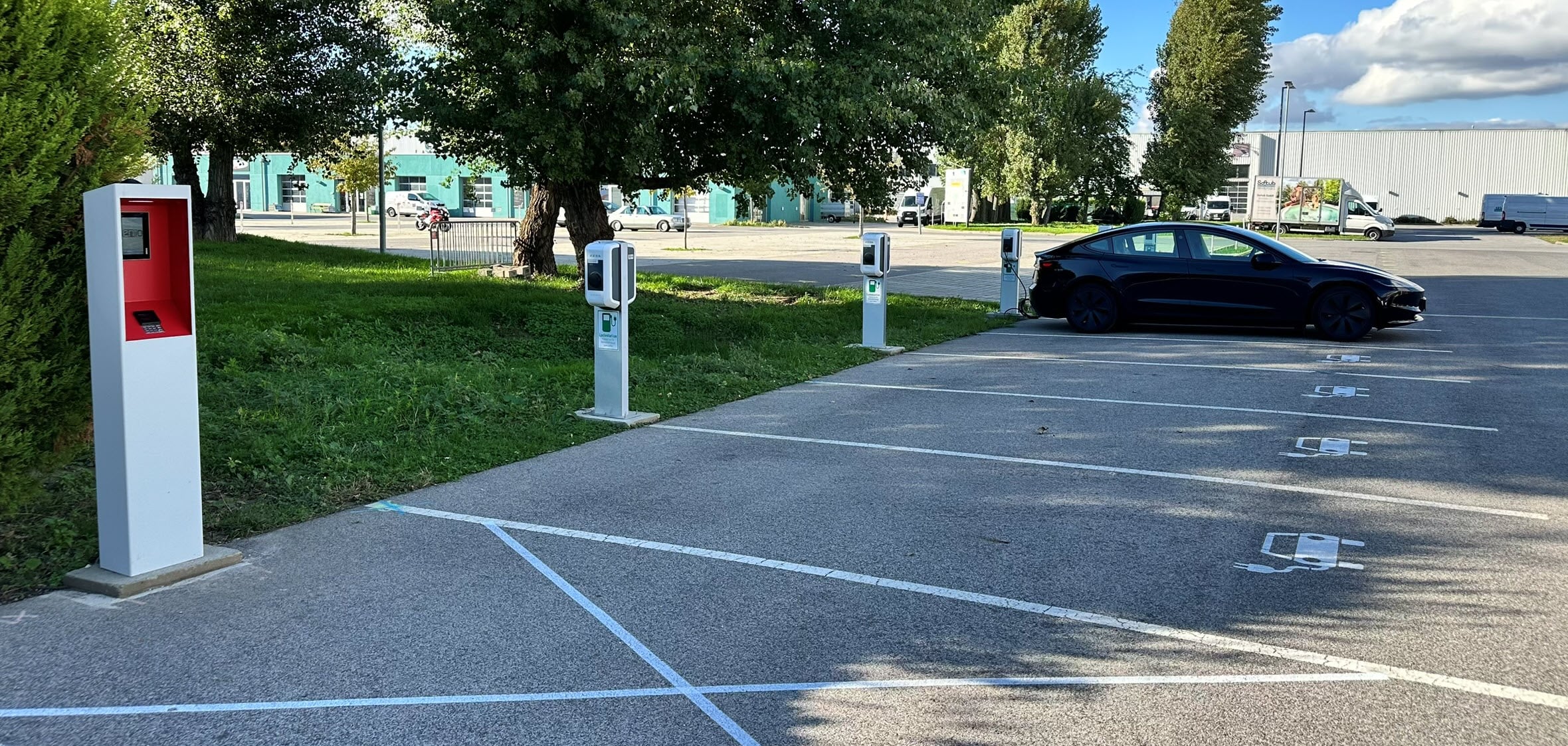
Tenants of the business park can rent a parking space including a charge point and pay a special rate per kWh charged. Billing for each tenant runs automatically through ENIO, so the operator has no work to do.
Load management and prioritised charging
With ENIO's load management, the owner saved a six-figure euro amount in grid connection costs. The tenants' RFID cards are linked not only to the load management but to individual load profiles as well. That guarantees, for example, that management can charge with priority and therefore faster.
Selling surplus electricity
Peaks at times when the business park needs little electricity are “sold” to guests particularly cheaply. That avoids negative feed-in tariffs, and at the same time it is a strong incentive for neighbours and for visitors to the surrounding supermarkets to charge their electric vehicle at a very good price.
The ENIO Payment Station for card payment at dynamic rates
To be able to guarantee the end customer a specific final price, several ENIO Payment Stations were installed, on which the relevant charge point is simply selected on the display. Visitors of the tenants — customers, suppliers, guests — as well as visitors to the fitness centre and the restaurants are shown the current price per kWh before the session starts.
A return without effort
On the basis of the charging history so far and the subsidies available for public charging infrastructure, the owner's investment will pay for itself within twelve months. After that, the margin between buying and selling electricity raises the owner's return. Because the charging infrastructure runs practically without day-to-day attention, there are no staff costs to set against it. With the combination of operation that needs no internal effort and a modest fee for the billing service, ENIO gives the operator the highest possible margin and a better return than any other provider.

In short
With solutions cut precisely to the customer — load management with prioritisation, dynamic pricing and direct billing through the ENIO Payment Station — ENIO can add real value to a property owner's building.
The combination of automatic operation and automated billing means the greatest possible return for the property owner and operator.
At the same time tenants are better served, because their requirements for individual charging arrangements and prices can be met.
More about the Donau office park can be found here.