
Stop buying more grid capacity than you need
Load management distributes available capacity dynamically across the charge points — by load profile, with prioritisation and without anybody intervening. The difference from energy management: load management governs the charging infrastructure, energy management governs every consumer in the company.
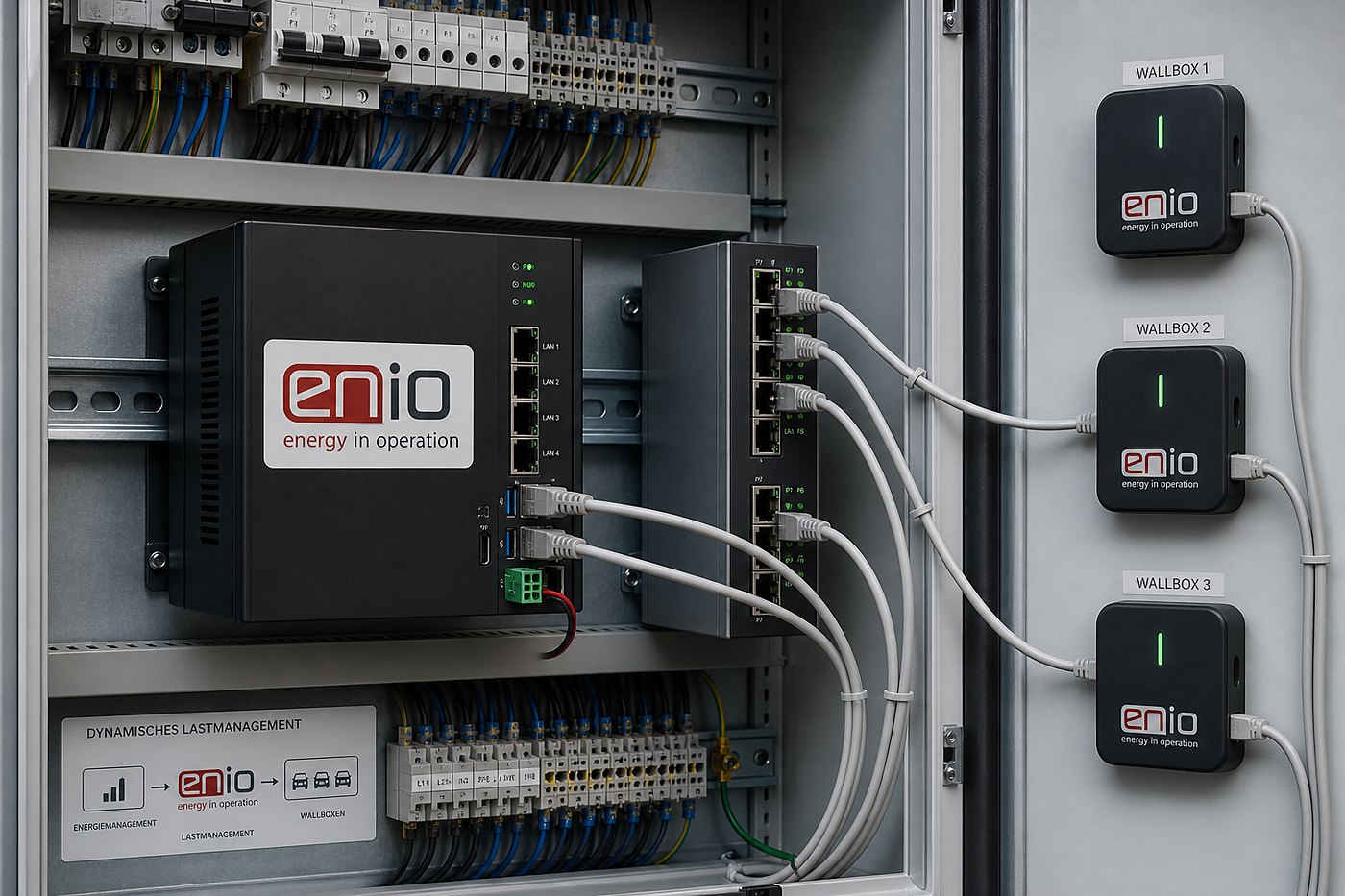 The site controller in the cabinet — dynamic load management right on site
What load management saves you
Two items depend on capacity rather than consumption: the one-off grid provision charge when you connect, and the capacity price every year. From 2027 the capacity price on grid level 7 is measured against the highest quarter-hour in each calendar month — every single peak counts. Set your case:
Three profiles, configurable in the backend
First come, first served
By analysing historic data and forecasts, this profile adjusts charging power to anticipate peaks and react proactively.
Balanced
Every vehicle charges at maximum capacity until power runs short. After that all charge points are throttled evenly — everyone keeps charging in parallel.
On-off balancing
If charging current drops below 3 kW the session pauses for 30 minutes and then resumes at a higher current.
The PRIO button
A field sales rep stops at the office for forty minutes; office staff stay eight hours. Without prioritisation both get the same power — and the field rep drives on half empty. Switch the mode, move the priority and drag the available power: the areas show how much power each vehicle receives over its stay.
Tap PRIO on a vehicle — or switch the mode above.
What sits on site
AC/DC charge point
Carries out the session, connected to the site controller by LAN.
Site controller
Coordinates the charge points, measures power continuously and talks to the backend.
Backend software
Controls the charge points and defines the load profiles — on site or over the air.