SPL Tele / Electrify and ENIO open an intelligent charging park with AI-based pricing
At a time of rising energy costs and growing demands on grid efficiency, one thing is clear: commercial success and sustainability are not a contradiction. With the new charging park in Wolkersdorf, in the Mistelbach district of Lower Austria, SPL Tele together with its subsidiary Electrify and ENIO makes a strong statement about the future of electric mobility.
The project combines up-to-date charging infrastructure with AI-based pricing — a milestone for efficiency, ease of use and economics.
A charging park that can do more
The new site combines AC and DC charge points, all managed and billed through the ENIO platform. A calibration-certified payment system provides maximum flexibility, accepting debit cards, credit cards and mobile payment.
One decisive difference from conventional systems:
Through the Payment Stations, operators can define time-dependent and flexible prices — something that is not possible with classic roaming cards. There the e-mobility provider sets fixed rates, regardless of the price of electricity or the load on the grid.
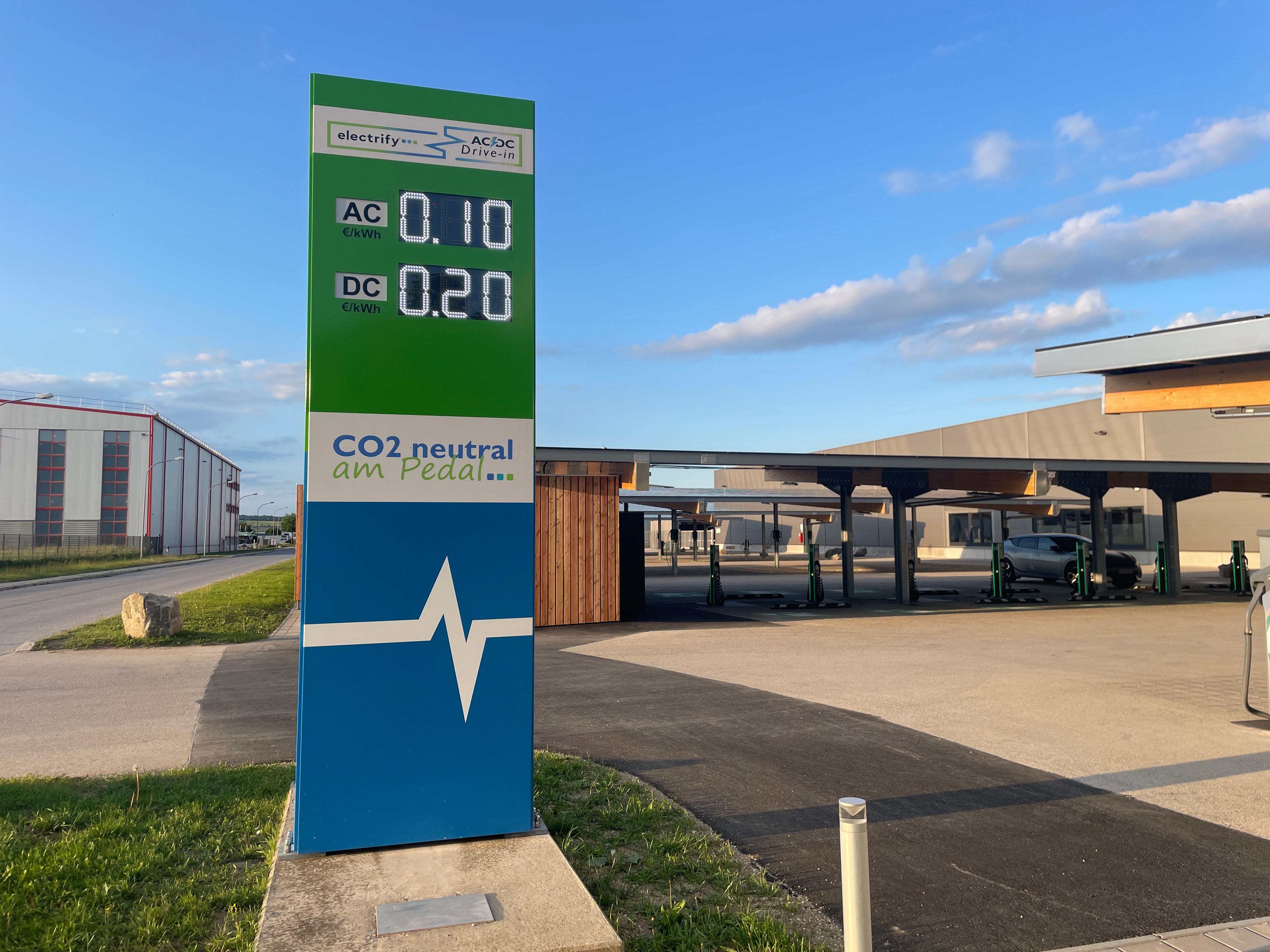
Alongside the charge points, modern carports with integrated photovoltaic systems were installed at SPL. As the pictures show, these carports not only give electric vehicles a sheltered parking space, they generate clean solar power on site at the same time. A large part of the energy the charging infrastructure needs is covered sustainably, and self-consumption is maximised — a good example of electric mobility and renewable generation working together.
For billing the dynamic tariffs, SPL Tele relies on the ENIO Payment Station. The intelligent software from Electrify calculates the current price in real time and defines the period for which it applies. That price information is then passed fully automatically through an API directly to the ENIO backend. This makes sure that every direct payment, debit or credit card payment, Apple Pay or Google Pay transaction through the ENIO Payment Station automatically applies the lowest currently valid rate — transparently, comfortably and entirely automatically.
The current rate is shown clearly on the display of the Payment Station. Users simply select the charge point they want to use and see the current price per kilowatt-hour on the display. This works for AC and DC charge points alike and creates maximum transparency and confidence in every session.
💡 Worth knowing:
Dynamic pricing works only with payments by debit or credit card at the ENIO Payment Station, and with ad-hoc payments by QR code.
With roaming cards — from ÖAMTC or Shell, for instance — the rates are fixed, so dynamic adjustment is not possible.
Dynamic pricing — what lies behind it?
Dynamic pricing means that charging prices are adjusted flexibly to outside conditions. Those conditions can be:
- the current supply of electricity and the load on the grid
- time of day and demand
- hourly electricity prices on the market
- local consumption, storage and solar data
The price can be lowered when solar generation is high, to create a deliberate incentive to charge. Conversely it can rise when the grid is under load, to avoid peak loads.
The result: a more stable grid, higher utilisation and a better contribution margin from the charging infrastructure — with no additional hardware.
The current price is shown on the display and also pushed as a notification through the ENIO charging app the day before.

Artificial intelligence as the control centre
To put this strategy into practice, Electrify developed its own AI-based software. It continuously analyses:
- historical consumption patterns of individual charge points
- forecast day-ahead electricity prices
- battery and solar capacity across several sites
On that basis the AI not only adjusts prices, it actively steers the flow of electricity between sites.
An example: if a photovoltaic plant in Mistelbach produces surplus energy at midday, it can be used automatically for charging in Wolkersdorf or stored on site — cost-optimised and automated.
An example: optimising across sites
Suppose one site expects high demand the following morning while another has a solar surplus at midday.
The AI then makes several decisions:
- Lowering the price at favourable times, to charge storage deliberately.
- Optimising the flow of energy between sites.
- Prioritising cheaper charging sessions when demand is strong.
This intelligent control leads to more revenue, lower energy costs and less strain on the grid — a win for the operator and for the energy supplier alike.
💶 What does dynamic pricing actually bring?
A calculation shows the potential:
A charging park with around 100 sessions a day and an average of 25 kWh per session reaches an annual energy turnover of roughly 912,500 kWh.
Through deliberate price adjustments, an additional contribution margin of 5 to 15 cents per kWh can be achieved, depending on the market.
That works out at:
- Best case (EUR 0.15/kWh): around EUR 136,875 additional return per year
- Conservative case (EUR 0.05/kWh): around EUR 45,625 additional return per year
👉 And all of it without investing in new charge points — purely through intelligent control of price and load.
From vision to reality
With the charging park in Wolkersdorf, SPL Tele and ENIO show how digital intelligence, decentralised generation and modern charging infrastructure come together into one coherent system.
The project proves that sustainable mobility can be attractive economically as well as ecologically — an example for cities, companies and energy suppliers.
What comes next: a rollout across Austria
Wolkersdorf is only the beginning.
SPL Tele is already planning to roll the dynamic solution out to further sites in Austria. The aim is intelligently controlled charging infrastructure across the country that brings economics and sustainability together.
This is what the Electrify charging park looks like at night:

💡 In short
With the right combination of intelligent software, dynamic tariffs and well-considered charging infrastructure, electric mobility can be run economically and with confidence in the future. ENIO supports operators through all of it — from the first idea through the concept to the finished charging infrastructure.
Beyond that we advise our customers on designing individual infrastructure concepts and matching payment models, to make sure every solution fits the site, the users and the commercial goals.
One further advantage: ENIO settles the GHG quota automatically — simply, transparently and with no additional effort for the operator. Our customers benefit not only from efficient infrastructure but from additional revenue out of the quota trade.
Further articles about this charging park can be found at orf.at and NÖN. The construction of the park can be watched on YouTube.
📩 Get in touch — and shape electric mobility yourself.